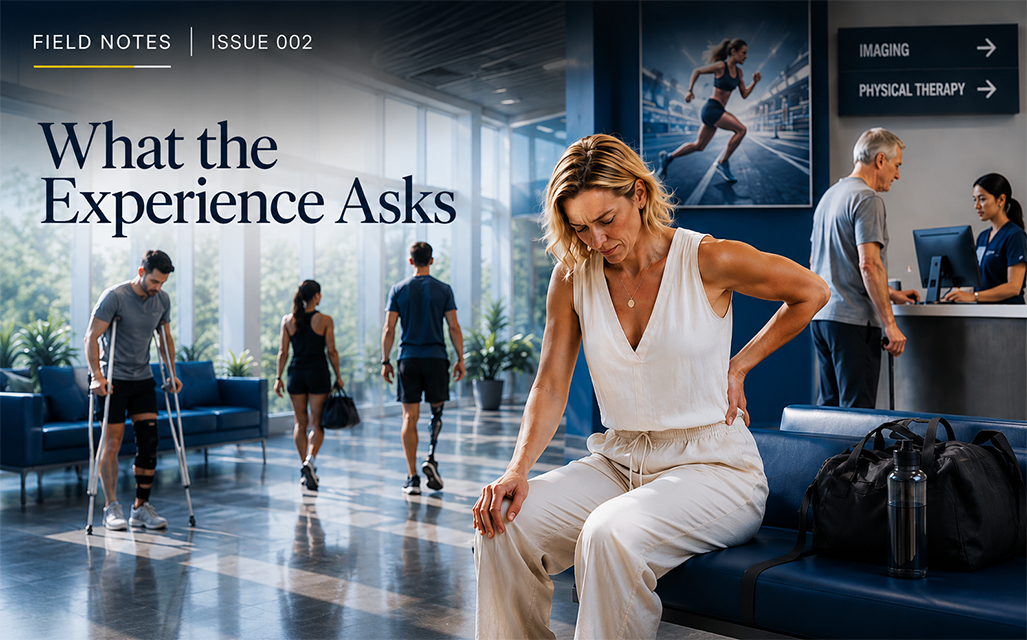
Field Notes • Issue 002: What the Experience Asks
Observations from the Built Environment
Standing hurts. Not the kind of discomfort most of us ignore. The kind that makes you shift your weight every few seconds, searching for a position that hurts a little less. The kind that has you leaning against the back of a chair or a reception desk for just a moment of relief. The kind that quietly turns every unnecessary step into something you calculate before taking it.
I happened to arrive at an orthopedic clinic carrying that reality myself.
Like many of the people walking through the doors that morning, I wasn’t there because moving felt easy.
Just inside the entrance is a kiosk.
Sign in here.
I do.
A receptionist appears on the screen. She smiles warmly and explains that I’ve come to the wrong check-in station. I need to walk to the end of the hallway and sign in there instead.
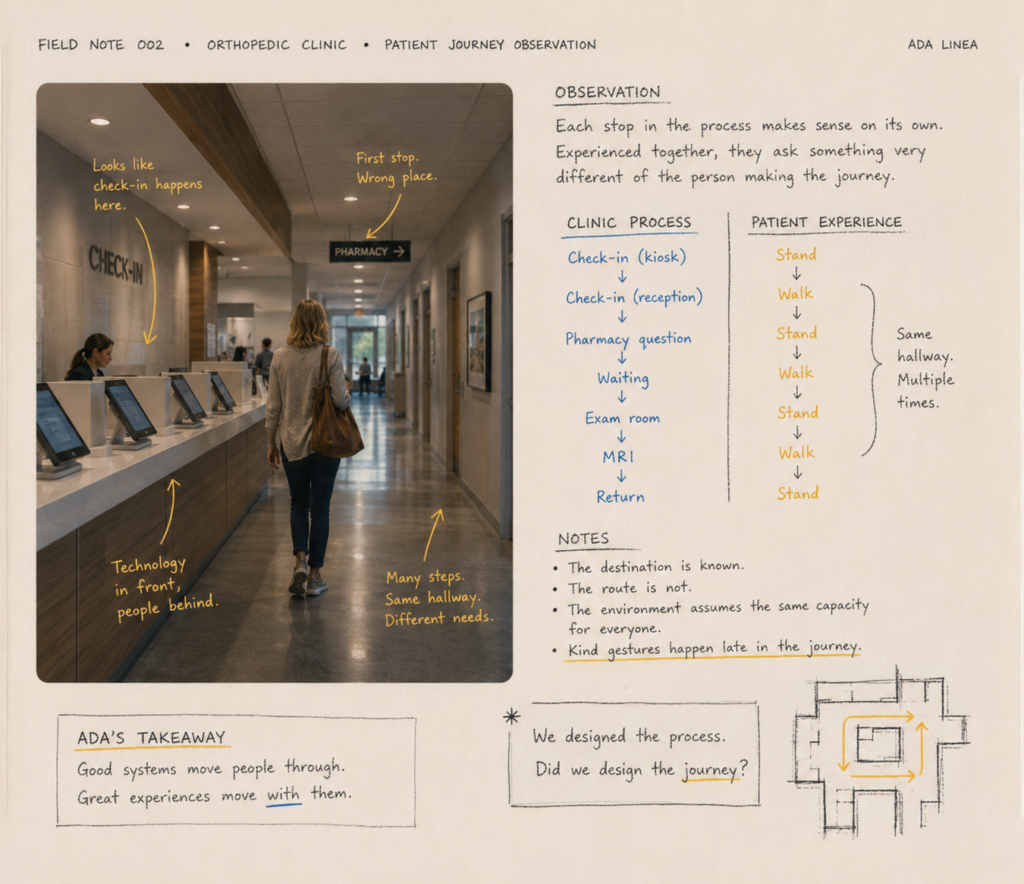
The second check-in area looks more familiar. A long reception desk runs along one side of the hallway, and several receptionists are working behind the counter. It looks exactly like the kind of place where you would walk up, answer a few questions, and check in.
As I get closer, I notice a screen sitting on the counter in front of each receptionist, facing the hallway. I assume I’ll be speaking with one of the people behind the desk.
Instead, my check-in begins with the screen.
I scan my driver’s license and insurance card, then answer a series of questions while shifting my weight from one foot to the other, searching for a position that hurts a little less.
After a few seconds, I turn to one of the receptionists.
“I’m not sure whether I’ve finished,” I say. “Would it be alright if I sat down?”
She smiles kindly.
“You’re fine. That’s for the next person.”
Only then do I realize the message isn’t meant for me at all. It’s simply letting the next patient know the screen is ready.
I finally sit down, grateful to get off my feet.
About a minute later, my name is called. I stand, walk back down the hallway, answer a single question about my pharmacy, and return to my seat.
A few minutes later, my name is called again. This time it’s from a doorway I had already passed before I ever reached the reception area. I stand, turn around once more, and head back down the same hallway.
Only then do I begin noticing the people around me differently.
A man balances carefully on crutches, someone steadies herself with a walker, another patient wears a walking boot. Across the waiting area, an amputee sits quietly, waiting to be called. It occurs to me that almost everyone here has come because movement has become difficult in one way or another. The environment isn’t serving a typical office population. It’s serving people whose relationship with movement has changed, whether temporarily or permanently.
The walk down the hallway isn’t asking the same thing of each of us.
Later in the visit, someone walks me to the MRI suite and back again. The route itself is straightforward. The escort comes only after the part of the journey that required the greatest amount of walking.
Somewhere along that short walk, something finally clicks: None of this is accidental. Every stop serves a purpose and every step follows a process.
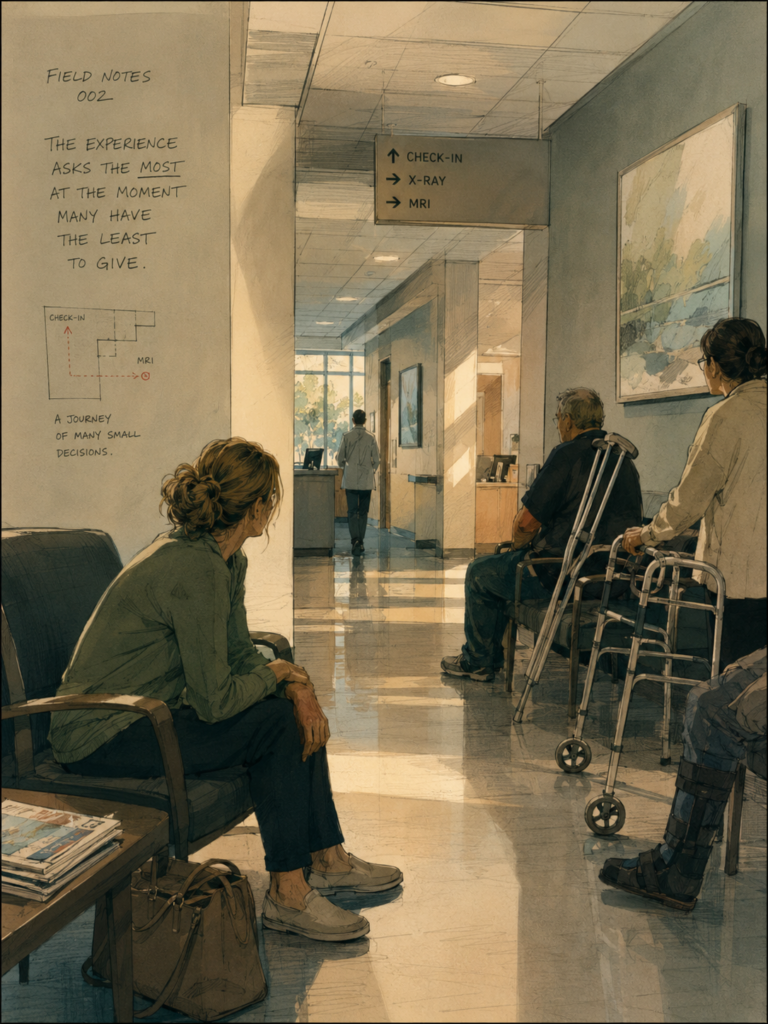
By the time someone walks me to the MRI, I’ve already checked in twice, walked the same stretch of hallway several times, and stood waiting while trying to figure out whether I was finished or whether another step was expected.
The escort comes after the part of the journey that asked the most of me.
The contrast stayed with me throughout the rest of the day. Every step in the process has been designed with care, yet I can’t help wondering what might change if the journey began with a different question.
What is this experience asking of the person who has arrived?
From Ada's Sketchbook
Notebook Transcription
Location
Sports Medicine Clinic, Check-In Sequence
Observation
The patient journey unfolds through a series of individually reasonable steps. Enter. Check in. Verify information. Wait. Move to another location. Wait again.
Each transition makes sense on its own. Experienced together, they create a journey that asks repeated physical effort of people who have come precisely because movement has become difficult.
Notes The process has been carefully designed. The patient experiences the accumulation. Those are rarely the same thing.
Notes
The process has been carefully designed. The patient experiences the accumulation. Those are rarely the same thing.
In Practice
Processes are often evaluated one decision at a time. People experience them as a whole. That difference may seem subtle, but it changes the questions we ask at the beginning of a project. Rather than asking whether each individual touchpoint works, I’m increasingly interested in what the entire journey asks of the people moving through it.
This experience reminded me that efficiency and empathy are not competing goals. A process can be carefully organized and still ask more of people than necessary. Every individual decision may make perfect sense, yet the sequence of those decisions can create a very different experience for the person living it.
The process may be measured in steps. The experience is measured in effort.

About Carolyn Friebner-Mueller
Carolyn Friebner-Mueller is the Founder and Creative Director of Dazu Creative, an Environmental Graphic Design studio based in Chattanooga, Tennessee. She specializes in wayfinding, signage, and communication systems for complex environments. She believes thoughtful design should be both beautiful and intuitive.
FIELD NOTES
Observations on Environmental Graphic Design, Wayfinding & Human Behavior
Published by Dazu Creative, LLC
© 2026