Environmental Graphic Design Is Not Decoration
Why Great Spaces Do More Than Look Beautiful
The best spaces do more than look beautiful.
They communicate.
They help people understand where they are, where they need to go, and how to move through space with confidence and ease.
This is the role of Environmental Graphic Design (EGD).
Yet despite shaping so much of how we experience the built environment, EGD is still often misunderstood. Too often, it is reduced to “signage” or treated as something added at the end of a project, after the architecture is complete.
But great Environmental Graphic Design is far more than labels on walls.
It is the layer that helps environments speak clearly.
So, What Is Environmental Graphic Design?
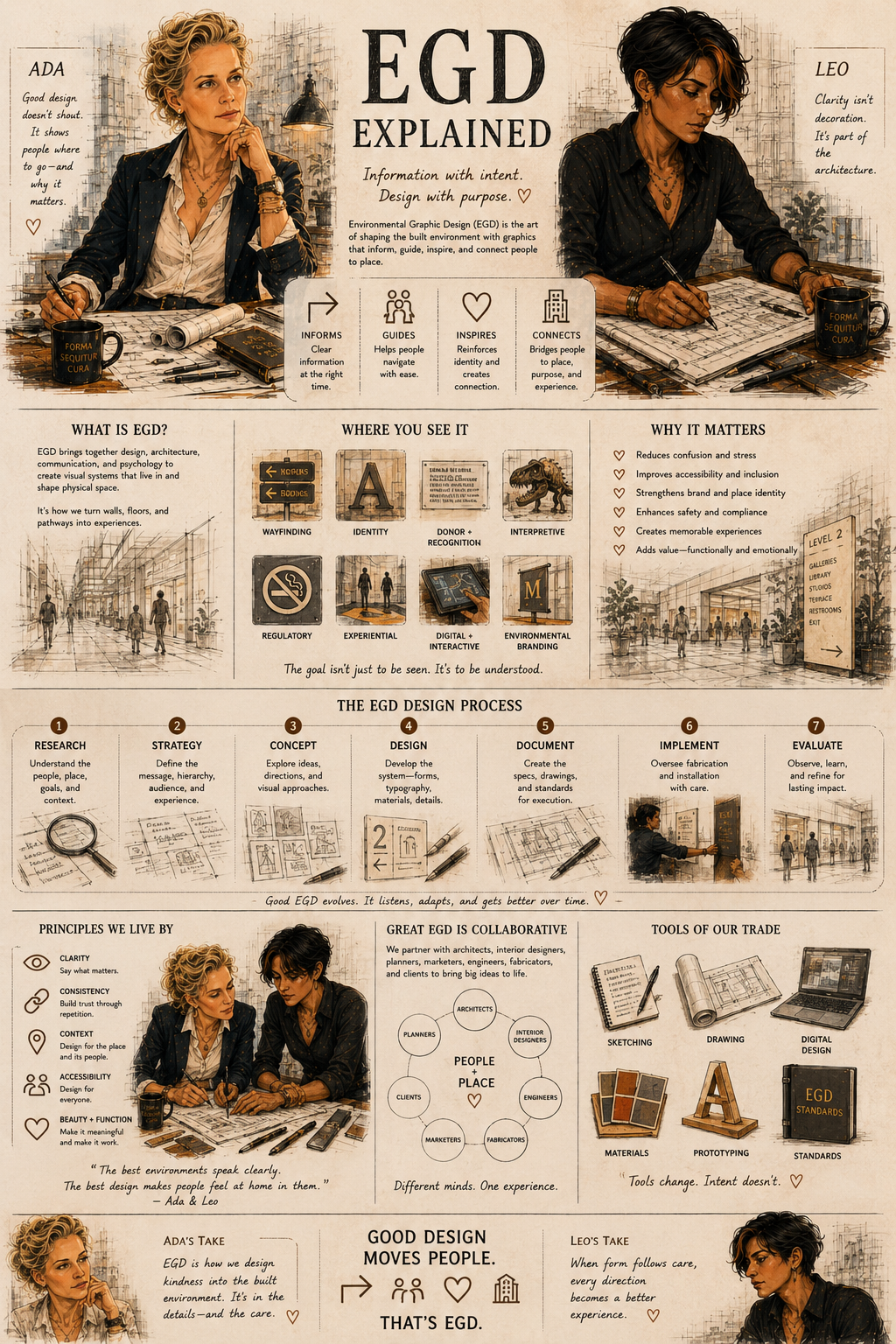
Environmental Graphic Design sits at the intersection of architecture, communication, psychology, and human behavior.
At its best, EGD helps people understand, navigate, connect with, and feel welcomed within a space.
It quietly shapes experience through:
• Wayfinding + navigation
• Identity + placemaking
• Donor recognition + storytelling
• Experiential graphics
• Regulatory + ADA signage
• Environmental branding
Done well, EGD often goes unnoticed.
Not because it lacks impact, but because it feels intuitive.
People simply know where to go.
They feel more at ease.
They move through a space with confidence rather than hesitation.
That quiet clarity is intentional.
Where You Experience EGD Every Day
Once you begin noticing Environmental Graphic Design, you realize it is everywhere.
In a hospital, thoughtful wayfinding can reduce stress for patients and families already navigating difficult moments. Clear information and intuitive navigation can help people feel calmer and more supported.
On a college campus, EGD helps students and visitors orient themselves, understand the identity of place, and move confidently through complex environments.
In parks and civic spaces, signage and interpretation can help people feel invited into a landscape, understand the history of a place, and navigate trails, amenities, and gathering areas with ease.
In museums, cultural institutions, and exhibits, storytelling, typography, spatial graphics, and interpretive elements transform information into experience.
And in workplaces, mixed-use environments, hospitality settings, and public spaces, Environmental Graphic Design reinforces identity and creates moments of connection that extend a brand into the physical world.
The strongest environments do not leave people guessing.
They communicate with clarity.
Why Environmental Graphic Design Matters
The impact of EGD goes far beyond aesthetics.
Thoughtful Environmental Graphic Design helps:
Reduce Friction
People should not have to struggle to understand spaces designed to serve them.
Clear communication removes confusion at decision points and helps people move intuitively through an environment.
Build Confidence
When environments communicate clearly, people feel more capable, welcome, and at ease.
This is especially important in healthcare, transportation, educational, and civic settings where confusion can create stress.
Create Belonging
Great places help people feel connected.
Environmental Graphic Design contributes to identity, meaning, and emotional resonance by reinforcing what a place stands for and how people experience it.
Support Accessibility and Dignity
Accessibility should never feel like an afterthought.
ADA and regulatory signage are essential components of equitable environments, helping people of all abilities move through spaces independently and confidently.
Protect the Experience of Architecture
Even beautifully designed buildings can feel confusing without a thoughtful communication layer.
Environmental Graphic Design helps extend architectural intent into the lived experience of the people using the space.
Because beautiful spaces should also be understandable.
The Cost of Bringing Signage in Too Late
One of the most common challenges in projects is timing.
Too often, signage and wayfinding are introduced at the end of a project when many critical decisions have already been made.
By then, opportunities may have been missed.
Sightlines may be compromised.
Decision points may not have been fully considered.
Architectural moments that could have supported intuitive navigation may already be fixed.
The strongest environments happen when Environmental Graphic Design is considered early, alongside architecture, interiors, landscape, and experience design.
When EGD is integrated from the beginning, the result feels seamless.
The communication layer becomes part of the environment rather than something applied to it.
And that difference matters.
Designing Spaces That Speak Clearly
At Dazu Creative, we believe the built environment should speak clearly.
Environmental Graphic Design is not simply about helping people get from point A to point B.
It is about creating places that feel coherent, welcoming, intuitive, and aligned with the original vision of the environment.
Because the best spaces do more than look beautiful.
They communicate.
And when environments communicate clearly, people move through them with greater confidence, ease, and connection.
What is a space you’ve experienced that made navigation feel effortless?
We’d love to hear.

About Carolyn Mueller
Carolyn Mueller is the founder of Dazu Creative, a strategic brand and environmental design studio focused on clarity, cohesion, and intentional growth. She works with established creatives and founders who are ready to refine their brand and elevate their presence through strategic alignment.