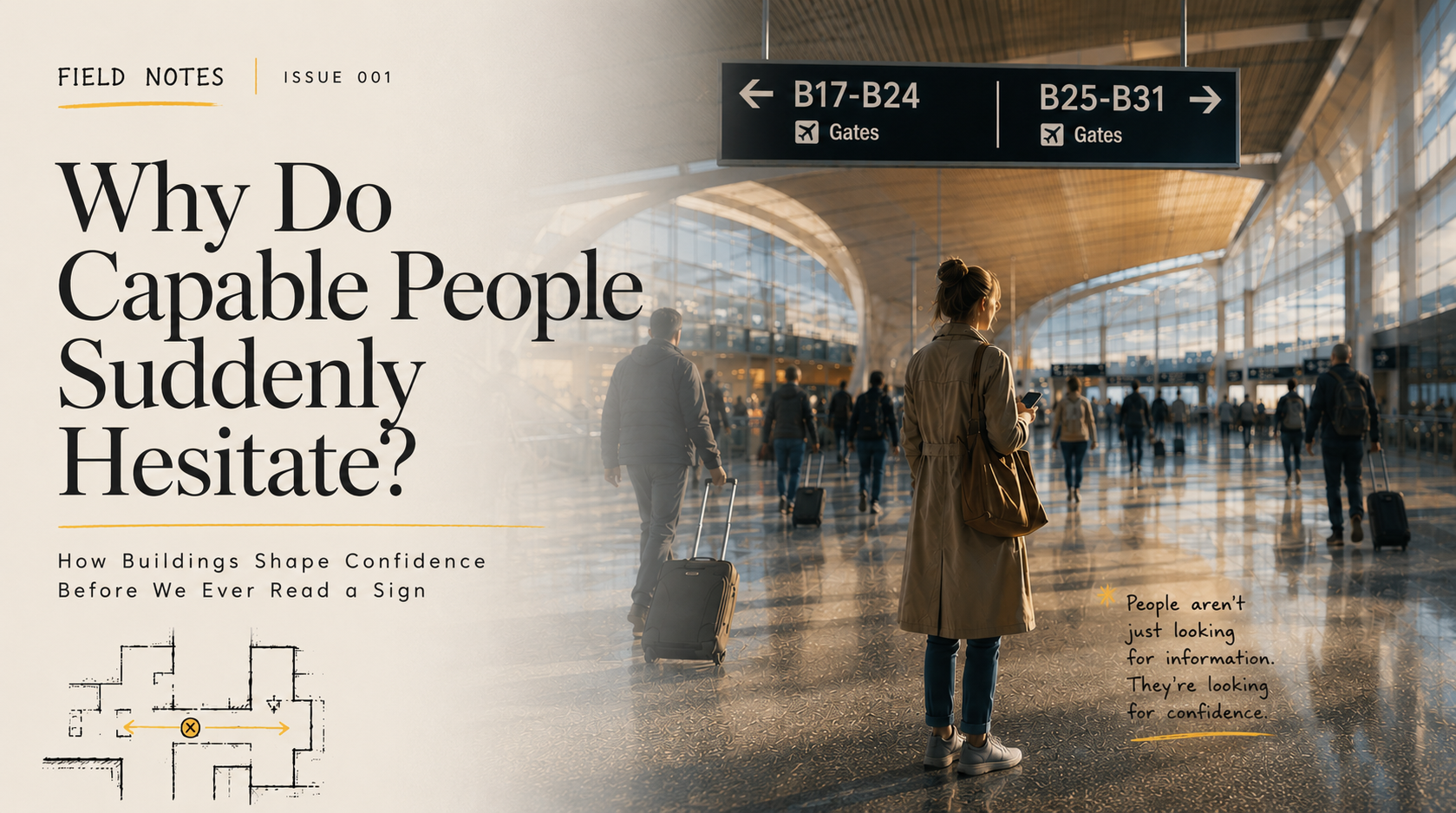
Field Notes • Issue 001: Why Do Capable People Suddenly Hesitate?
Observations from the Built Environment
There’s a moment I find myself watching over and over again.
It happens most often in airports, although I’ve seen it in hospitals, museums, university campuses, and parks as well. Someone is walking with purpose. They know where they’re trying to go. Then, almost imperceptibly, they slow down. Their eyes move before their feet do as they take in the space around them, looking toward one corridor, then another, searching for reassurance before continuing on their way.
The pause lasts only a few seconds. Most people around them never notice it. I do.
I’ve spent more than twenty years designing environments that help people understand where they are and where they need to go. Somewhere along the way, I realized those brief moments of hesitation reveal more about a place than almost anything else.
People often ask how I know whether a wayfinding system is successful.
It’s a fair question, and the answers they expect are usually technical. We talk about typography, viewing distances, sign placement, accessibility requirements, and visual hierarchy. Those things matter. They’re fundamental to good Environmental Graphic Design, and every one of them contributes to how people experience a place.
They just aren’t where I begin.
I begin by watching people.
What surprised me over the years is that the people who hesitate are rarely lost. Most know exactly where they’re trying to go. They have a boarding pass with a gate number, a patient room written on a slip of paper, or directions to a meeting they’ve attended many times before.
They’re waiting for the environment to reassure them that they’re still on the right path.
By the time someone looks for a sign, they’ve already formed an impression of the building. They’ve been reading light, proportion, sightlines, materials, movement, and the behavior of the people around them without realizing it. We all do. It’s one of the ways we decide whether a place makes sense.
The questions are rarely conscious, but they’re there.
Am I going the right way?
Does this feel right?
Can I trust what this building is telling me?
Long before anyone reads a directional sign, the environment has already begun answering those questions.
That’s one of the reasons airports fascinate me.
Few environments ask more of the people moving through them. Every day they welcome seasoned business travelers, first-time flyers, families juggling children and luggage, visitors navigating an unfamiliar language, and people carrying everything from excitement to grief.
No matter who they are or why they’re traveling, I keep noticing the same thing.
The people who hesitate are rarely the least capable. They’re often the most attentive. They’re reading the environment because, for a brief moment, it has stopped making sense.
The longer I’ve paid attention to those moments, the more I’ve come to believe they reveal something much larger than wayfinding.
They reveal the relationship between people and place.
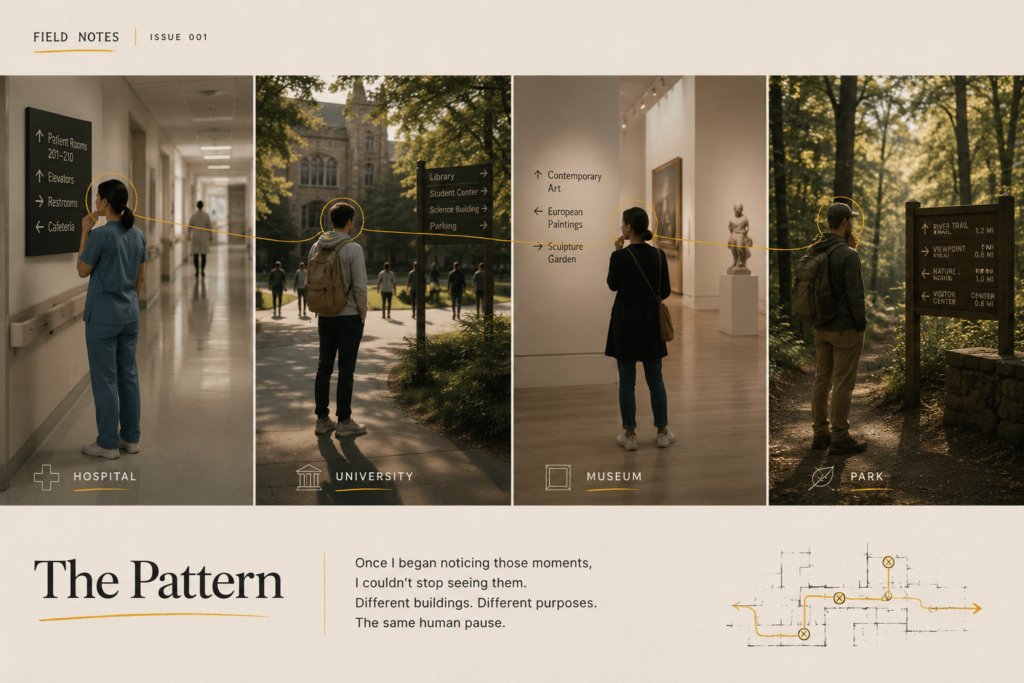
Once I began noticing those moments, I couldn’t stop seeing them.
At first I assumed airports were unique. They aren’t.
I started seeing the same hesitation in hospitals, where visitors stepped off an elevator and instinctively looked in both directions before choosing a corridor. I noticed it during the first week of classes on university campuses, when students slowed outside unfamiliar buildings before deciding they were in the right place. It appeared in museums as people paused at the entrance to a gallery, trying to understand where the exhibition wanted them to begin. Even in parks, where movement feels less structured, visitors stopped at trail intersections before committing to a path.
Although the settings changed, the hesitation never really did.
For a while I assumed those pauses were simply the result of complexity. Airports are complicated. Hospitals can be overwhelming. Large campuses take time to learn. It seemed perfectly reasonable that people would need a moment to orient themselves.
Then I noticed something that challenged that assumption.
The hesitation wasn’t caused by complexity alone. It appeared whenever the environment stopped communicating clearly.
That realization changed the questions I asked at the beginning of every project. Instead of asking where a sign should go, I found myself asking a much more fundamental question.
What is this environment already saying?
Every environment begins communicating before a single sign is installed.
A wide corridor quietly suggests that it’s the primary route. Daylight draws people toward an entrance. A change in ceiling height signals that one space is more important than another. Materials, sightlines, thresholds, and even the movement of other people all become part of a conversation we experience before we’ve consciously read a word.
When those cues work together, people rarely think about wayfinding at all. They simply continue moving because the environment keeps answering their questions before they have to ask them.
When those cues break down, the building quietly hands those questions back to the visitor.
Am I still going the right way?
Did I miss the entrance?
Should I turn here?
Most people recover quickly. They find the meeting room, catch the flight, or arrive at the appointment without anyone realizing they hesitated.
What they don’t recover is the attention they spent getting there.
For a few moments, the building asked them to solve a problem it could have solved itself.
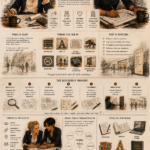
From Ada's Sketchbook
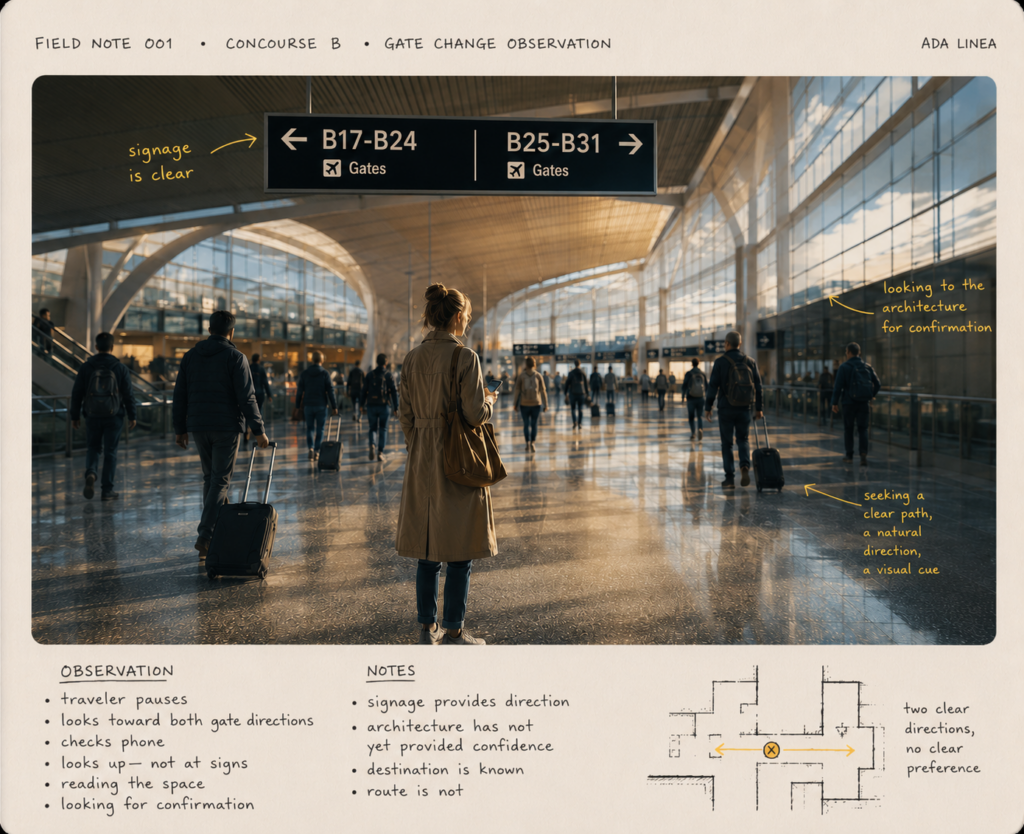
Notebook Transcription
Location
Concourse B, Gate Change
Observation
A traveler pauses after a gate change announcement. She appears calm and experienced, looking first toward one corridor, then the other before checking her phone. Her attention returns to the space rather than the signs, as though she’s waiting for the environment to confirm she’s still on the right path.
Notes
Destination known.
Route uncertain.
Signage provides direction.
Architecture has not yet provided confidence.
Confidence
It took me years to understand what I was really seeing.
When I first began my career, I thought wayfinding started with signs. If someone missed an entrance, we added another one. If they took a wrong turn, we added another decision point. I assumed our work began when confusion appeared.
Eventually, I realized I was asking the wrong question.
Instead of asking where another sign belonged, I began asking what the building was already communicating.
That changed the way I looked at every project.
People begin reading a building long before they look for information. They notice whether an entrance feels welcoming, whether circulation seems intuitive, and whether the space gives them confidence to keep moving. Most of those judgments happen instinctively. We don’t think about them. We simply respond.
By the time someone looks for a sign, the environment has already been speaking to them for quite a while.
That’s why I’ve come to think about signage differently.
Signs are important, but they aren’t the beginning of wayfinding. They’re one part of a much larger conversation that includes architecture, interiors, landscape, lighting, materials, and every decision that helps people understand where they are and where they should go next.
When those elements work together, people rarely think about wayfinding at all. They simply move through a place with confidence, giving their attention to the reason they came instead of the effort it takes to get there.
What interests me most is creating environments that never ask people to carry unnecessary confusion in the first place.
The next time you walk into an unfamiliar building, you may notice those moments too.
Watch the places where people slow almost imperceptibly. Notice where they instinctively look for reassurance. Pay attention to the environments that seem to answer questions before they’re ever asked, and the ones that quietly hand those questions back to the people moving through them.
Once you begin seeing those moments, it’s surprisingly difficult to stop.
Beautiful buildings have the power to inspire us. The very best ones pair beauty with clarity, allowing us to experience the architecture instead of spending our energy trying to understand it.
The longer I pay attention, the more convinced I become that good design isn’t measured only by how much people notice it.
It’s also measured by how confidently they move through it.

About Carolyn Friebner-Mueller
Carolyn Friebner-Mueller is the Founder and Creative Director of Dazu Creative, an Environmental Graphic Design studio based in Chattanooga, Tennessee. She specializes in wayfinding, signage, and communication systems for complex environments. She believes thoughtful design should be both beautiful and intuitive.
FIELD NOTES
Observations on Environmental Graphic Design, Wayfinding & Human Behavior
Published by Dazu Creative, LLC
© 2026